
 German
 French
 Italian
 English
 Guaranteed Fair Trade Organization

For Wholesale Partners
Our products and prices listed on this website are available exclusively for wholesale buyers.
Get in touch with us for more details
Hispanic bishops’ visit gives them firsthand look at Holy Land reality
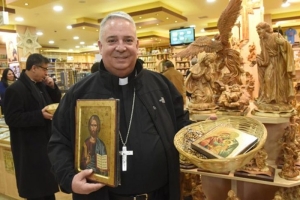
BEIT SAHOUR, West Bank - Retired Bishop Placido Rodriguez of Lubbock, Texas, remembers the smell of woodworking and the feel of wood in his hands from when he was a child in his family furniture factory in Celaya, Mexico.
“Here they are working with olive wood; in Mexico we worked with cedar. We see the connection with our brothers here,” Rodriguez said as he walked through the small family-run Odeh Factory, which produces traditional olive wood statues and souvenirs to sell to pilgrims and tourists. “I see the effort that is needed, and the talent, (to do this work) as a way to support and feed their families. I can see this is the work of Christians. I don’t have to be told that, you can see it in their work.”
Rodriguez was among 10 bishops who participated in the Jan. 18-27 USCCB Hispanic Bishops’ Pilgrimage for Peace in the Holy Land. They met with local Christians as well as with other Palestinians and Israelis to get a firsthand understanding of the situation and to advocate for “bridges not walls.” Many bishops said the pilgrimage gave them a better understanding of the Palestinian Christian reality in the Holy Land and gave them the opportunity to express their solidarity with the community, which makes up less than 2 percent of the Palestinian population.
On Jan. 27, Catholic Relief Services hosted the bishops in the traditionally Christian village of Beit Sahour, near Bethlehem, for a tour of the CRS Fair Trade Partner Holy Land Handicraft Cooperative Society, and a visit to one of the artisan workshops CRS recently helped renovate to improve working conditions.
“It has given me a special understanding of the reason why the number of Christians in the Holy Land is decreasing and the difficulty of living here because of the occupation,” said Bishop Felipe de Jesus Estevez of St. Augustine, Florida. “While I have felt a great sadness at their situation, I have also marveled at the resilience of the Holy Family Parish in Gaza.”
Bishop Nelson J. Perez of Cleveland described Gaza with its 2.3 million people as a “virtual human prison,” where residents cannot leave and others cannot enter. While there is a political aspect to the situation, the humanitarian side of it cannot be ignored, he said.
“People have the right to freedom of movement, right to life. I would hope that somehow, someday this will get resolved,” he said. “Both the Israelis and the Palestinians have their narrative, but (the situation must be dealt with) in a way which respects the dignity of the human person.”
He said although the students of Bethlehem University with whom they spoke gave him hope as they expressed desire for peace, their prospects for gainful employment were minimal, and many young Christian Palestinians emigrate because of lack of work.
“We can’t judge one side over the other but … justice and peace must reign between these two communities living here,” said Auxiliary Bishop Alberto Rojas of Chicago. “This is possible only if each one recognizes the dignity of the other.”
“We have been exposed more to the reality of life here and have heard … of the fear of Israelis near the Gaza border,” said Perez. “I could relate to the fear of being shot at. People have died. That was as disturbing as seeing the limitation of movement of people from Gaza.”
“There have been situations in the world where, in their moments, people felt there was no hope and there was nothing to be done,” he added. “But history has shown through God’s grace and intervention and goodness of people, situations have changed.”
Palestine: Gender Equality Starts At Home
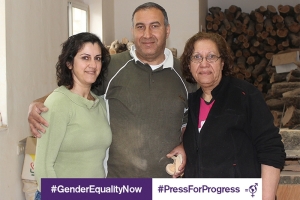
Salsa’s Olivewood workshop was constructed by a father of six sons who taught them the craft of olive wood carving, in 1920. For the family, it became the main source of income. Philip, one of the six sons, passed on the family craft to his own sons Rafat and Bishara.
Rima, Philip’s wife, decided to work with them against their will. Philip initially denied her request to join the workshop because he believed that it is not a woman’s place. Rima did not listen to her husband. She knew that she could make a lot to help improve the family’s income. She is also talented. She had always dreamt of transforming objects into beautiful pieces. Now Rima, her son Bishara and his wife Shurouq (her name means sunrise) converted a very small room in their house into 3 workshops.
"It is not just the woman’s magic touch on the product,” said Bishara. “When they are gluing the pieces women are able to do it faster and with more precision than us men. Shurouq is an expert now, many of the new models are created by her and she is very grateful to Rita who motivated her to work and be independent”.
Very proud, his wife Shuroug added, “I’m able to secure the education of my children, something that many families could not do, even if their children are good at school.”
Rima is thankful she made the right decision to interfere in the family business. “Thank God that my family appreciates what I am doing,” she said.“I am proud to be a woman who appreciate moral values and women’s rights. I am proud to spread this kind of example to other women in my community.”
Holy Land Handicraft Cooperative (HLHCS) has been selling Salsa’s Olivewood products for more than 15 years. The long-term relationship has ensured continuity of income for the family. Recently, the workshop has received support from Caritas Jerusalem and Initiative Christlicher Orient in Austria to improve the workshop to reduce dust and noise.
Story contributor: Holy Land Handicraft Cooperative Society
For Internationa Women's Day 2018 celebration
The Story of Nagla Bannoura Issa Saliba
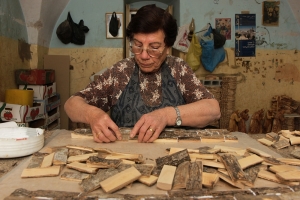
Nagla Bannoura Issa Saliba is a 75 year old woman from Palestine. Despite all the challenges she has faced in life, her hard work and determination paved a better life for her children and even grandchildren. Nagla got married very young and despite growing up in a male dominated society, she always believed that women could also work and help provide for the family. When Nagla lived in Jordan with her husband, she wasn’t able to work .
“It wasn’t easy at all for women to leave the house to go looking for work”
When her children were old enough to go to school, she decided to return to Palestine even though it meant being separated from her husband. She was able to save some of the money her husband sent to her and with her savings she bought a piece of land.
“I will never forget the great day when I made the first floor of my house, it was in June 1962”
However, soon the bills began to pile up and she began looking for work. At first she started weaving all day and night, but it wasn’t enough. In 1979 her brother started an olive wood workshop and asked her to join him. They worked very hard together for ten years before the workshop joined the Holy Land Handicraft Cooperative Society.
“From that day many good things happened…people from the cooperative explained to my brother the importance of being fair with his employees and with himself. Now we work 7 hours per day, women can do their job easier, with dignity in a healthy and clean place. When I look back and remember everything that happened to me for being a woman, without rights, I can only laugh and thank God that my children will have something better because there is an organization like the WFTO that is concerned about our rights”
Source: https://serrvartisans.wordpress.com/2014/05/05/the-story-of-nagla-bannoura-issa-saliba/
Basma Barham And The Women-Led Social Enterprise Making It Work In Palestine
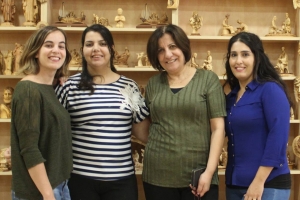
Holy Land Handicraft Cooperative Society: Imagine running a social enterprise in Palestine that is leading the way in women’s empowerment. This is the story of Holy Land Handicrafts, a commercial success that’s showing social enterprise can work in even the toughest of contexts.

Audio File

Podcast Author
For original source click here
Internship and Volunteer Opportunity
Internship and Volunteer Opportunity aims to raise a deeper understanding of Fair Trade by facilitating opportunities for who are interested, sympathetic, or advocates of Fair Trade principles. Volunteers can actively take part in the daily operations of our activities as a Fair trade organization.
Who can volunteer?
College, university and faculty students. Volunteers can be part of a program or seeking to gain work experience in Fair Trade.
Possible Areas of Assignment
- Communications and research
- Events organizing
- Advocacy and campaigns
- Monitor artisan workshops, which should follow the fair trade principles, working with the WFTO internal monitoring process
- Seller at our souvenir shop
For how long?
Depends of the availability on the intern, but should not be less than 2 months.
Requirements
Applicants should submit the following requirements to info@hlhcs.org
- Curriculum Vitae or Resume with Character reference
- Recommendation letter from a previous employer or College, university or faculty
This volunteer position is an immediate and ongoing opportunity that will be based in Beit Sahour, Palestine.